
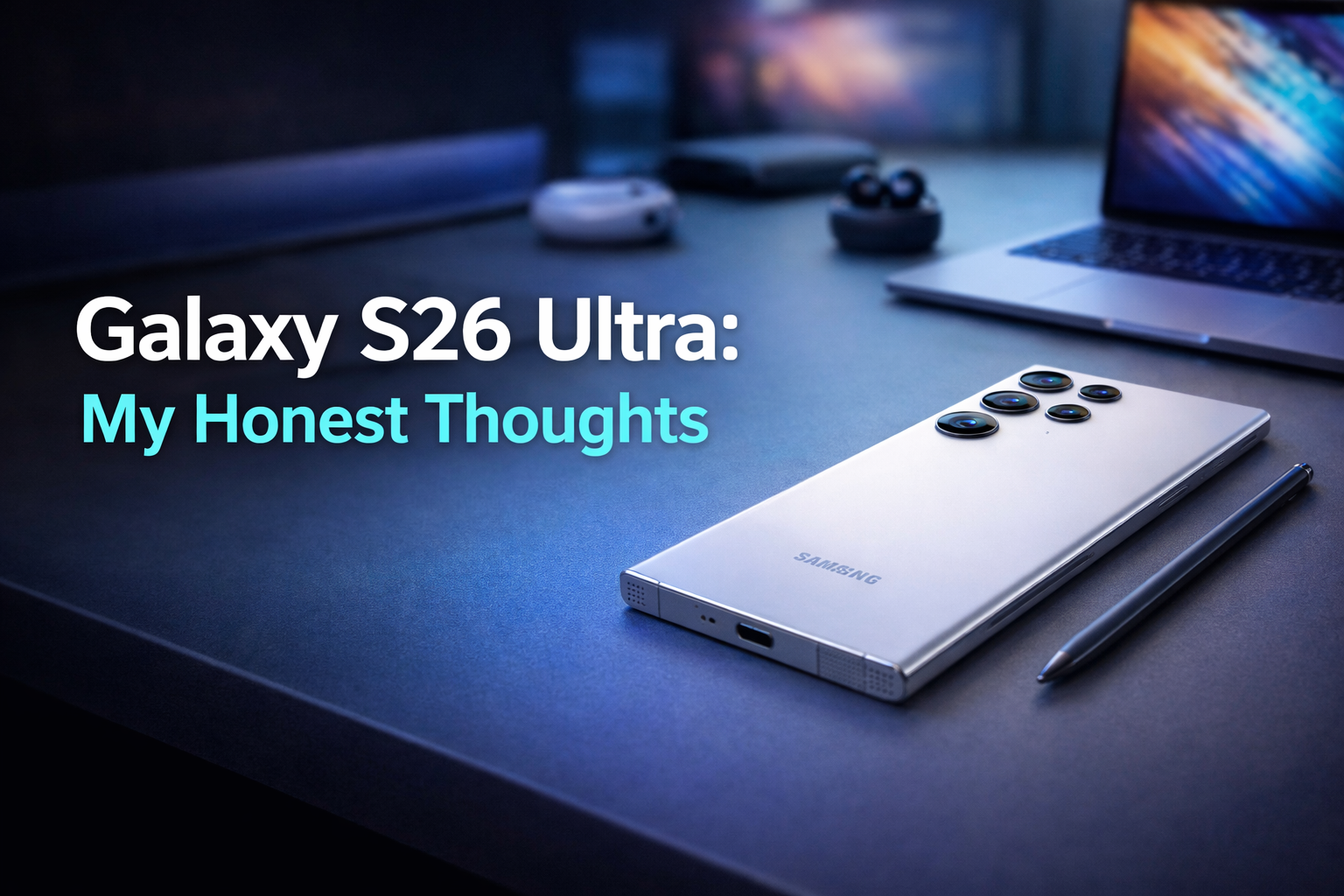
My Thoughts on the Galaxy S26 Ultra
The Samsung Galaxy S26 Ultra was just announced, and like every flagship launch the internet immediately went into debate mode. Some people are calling it the best Android phone ever made. Others are calling it boring. As always, the truth probably sits somewhere in the middle. After looking through the specs and thinking about where smartphones are right now, I think the Samsung Galaxy S26 Ultra is a very good phone. In fact, it might be the best Android flagship you can realistically buy in the United States. But at the same time, it also feels like another example of how smartphones have matured. The leaps we used to see every year simply are not happening anymore. What we are getting instead are refinements.
Before getting into the details, I should probably mention something that might surprise people. I will not be buying the S26 Ultra. That is not because it is a bad device. It is mostly because of how I personally use smartphones now. Over the past few years I have gravitated toward foldable phones. Once you get used to the extra screen real estate of something like Samsung’s Fold line, going back to a traditional slab phone feels limiting. The ability to open the phone and instantly have a small tablet in your pocket changes the way you use the device. Because of that, candy bar style phones have to do something very different to catch my attention again. The S26 Ultra is extremely powerful, but it does not really change the formula in a way that makes me want to switch.
From a performance perspective, the phone is exactly what you would expect from Samsung’s flagship line. It runs on the new Snapdragon Gen 5 for Galaxy processor, which is slightly overclocked compared to the same chip found in other Android phones. Samsung has worked with Qualcomm for years to squeeze a little extra performance out of these chips for their devices. Combined with the larger vapor chamber and the shift to an aluminum frame designed to dissipate heat more efficiently, the S26 Ultra should maintain higher performance during long gaming sessions or extended video recording. In real world use, though, performance stopped being a problem for most people a long time ago. Even phones that are two or three years old are still incredibly fast. So while the extra power is nice, it probably will not be the deciding factor for anyone thinking about upgrading.
The display is where Samsung has always excelled, and the S26 Ultra continues that tradition. On paper the screen looks very similar to last year’s model: a 6.9 inch Dynamic AMOLED panel with QHD resolution and a 120Hz refresh rate. But Samsung did introduce two changes that are worth talking about. The first is the shift to a 10-bit color display. That means the screen can show a much wider range of color gradients compared to the 8-bit panels used in previous models. If you edit photos or videos on your phone, this can make a noticeable difference. Skies look smoother, shadows transition more naturally, and colors overall appear more accurate. It is one of those improvements that might not jump out immediately but does add to the overall experience.
The other display feature is a bit more unusual. Samsung has integrated a privacy screen directly into the display itself. Anyone who has used a privacy screen protector knows how these work. When you look at the screen from an angle, it becomes very difficult to see what is on it. Only the person looking directly at the display can see the content clearly. Samsung built that functionality into the screen so it can be turned on or off through software. You can even set it to activate automatically for certain apps, like banking or messages. It is a clever idea and could be genuinely useful for people who commute or frequently use their phone in public spaces.
There is, however, a trade-off. Even when the privacy feature is turned off, the display is slightly less bright and a little less clear than the S25 Ultra. It is not a huge difference, but it is noticeable if you are comparing them side by side. Personally, I already use a privacy screen protector on my iPhone, which cost around thirty dollars, so the idea of having it built into the phone is interesting. But at the same time, not everyone will use the feature, which makes the compromise a little harder to justify.
The camera system is another area where Samsung chose refinement over reinvention. The S26 Ultra continues using the same general setup Samsung has relied on for several generations now. You still have the 200-megapixel main camera, the 50-megapixel telephoto with 5x optical zoom, the 50-megapixel ultra-wide camera, and the familiar 100x space zoom capability. The front camera remains a 12-megapixel sensor. Samsung did adjust the aperture slightly to allow more light into the main sensor, which should help with low-light photography. They also made changes to the color science, which should improve point-and-shoot photos without requiring editing. But overall, this is very much an evolution of the same camera system rather than something dramatically new.
One feature that did catch my attention is the addition of Horizon Lock for video recording. Essentially, the phone uses the massive resolution of the 200-megapixel sensor to crop and stabilize the frame in a way that keeps the horizon level even if the phone rotates slightly while recording. For people filming handheld videos, YouTube Shorts, or TikTok content, this could make footage look much more stable without needing a gimbal. It is a smart use of the large sensor, and it shows how software is becoming just as important as hardware in modern smartphone cameras.
Like every flagship device in 2026, the S26 Ultra is also leaning heavily into artificial intelligence features. The phone runs Android with One UI 8.5 and includes Samsung’s latest Galaxy AI tools. One interesting change is the integration of Claude AI alongside Samsung’s existing AI capabilities. The idea is to allow the phone to complete multi-step tasks on your behalf. Instead of just answering questions, the phone can actually take actions for you. For example, you might say something like 'I’m running late for a meeting, book me an Uber,' and the phone could check your calendar, determine the destination, calculate the timing, and prepare the ride request for confirmation.
Samsung also increased charging speeds for the first time in several years. The S26 Ultra now supports 60-watt wired charging through USB-C, which is an improvement over the previous 45-watt limit. Wireless charging has also been increased to 25 watts. It is not the fastest charging available in the Android world, but it is still a welcome step forward.
However, there is one decision Samsung made that genuinely frustrates me. Despite improving wireless charging speeds, they still chose not to include magnetic alignment in the phone itself. Apple introduced MagSafe years ago, and the Android ecosystem now has the Qi2 standard which supports similar magnetic accessories. These magnets allow chargers, battery packs, wallets, and even camera accessories to attach securely to the back of the phone. Samsung decided to leave the magnets out and rely on phone cases to provide them instead.
Another reality that is important to mention is the difference between the global smartphone market and what we actually have access to in the United States. Internationally there are some incredible Android phones available. Devices like the Xiaomi Ultra series or Honor’s flagship phones often push hardware boundaries even further than Samsung does. But importing those phones can create compatibility issues with carrier bands, software support, and warranty service. Samsung’s advantage in the U.S. market is convenience. If something goes wrong with your device, there are Samsung stores, Best Buy partnerships, and carrier service centers that can help. That level of support matters for a lot of people.
Should You Upgrade to the Samsung Galaxy S26 Ultra?
So should you upgrade to the S26 Ultra? The answer depends entirely on what you are using right now. If you already have an S24 Ultra or S25 Ultra, there really is not enough here to justify spending another thousand dollars. The improvements are real, but they are incremental. If you are coming from something older like an S22 or S23, the upgrade will feel much more meaningful. But this is not the kind of yearly leap that used to define the smartphone industry.
And maybe that is the real story here. Smartphones have reached a point where even small improvements require enormous engineering effort. The devices we carry today are already incredibly powerful. Cameras rival dedicated equipment, displays are stunning, and performance is far beyond what most apps require. Because of that, progress now comes in smaller steps.
The Galaxy S26 Ultra represents one of those steps. It is a polished, powerful flagship that will serve its owners extremely well. But it is also a reminder that the smartphone industry has matured. The revolution already happened. What we are seeing now is refinement.
If you want to hear the full breakdown and my immediate reactions to the announcement, you can listen to this episode of Tek With Josh on Apple Podcasts or Spotify. On the podcast I talk through the specs, the industry trends, and where devices like this actually fit into the bigger smartphone landscape.